

On-brand AI: Why your brand needs a recipe, not a prompt
Build the repeatable AI processes your team actually needs
By Alex Gnibus, Enterprise Product Marketing
Key Takeaways:
Prompt engineering can produce good results at first, but it becomes complex, time consuming, and inconsistent at scale.
Relying on out-of-the-box models leads to generic outputs and potential brand risk, especially when competitors use the same tools and data.
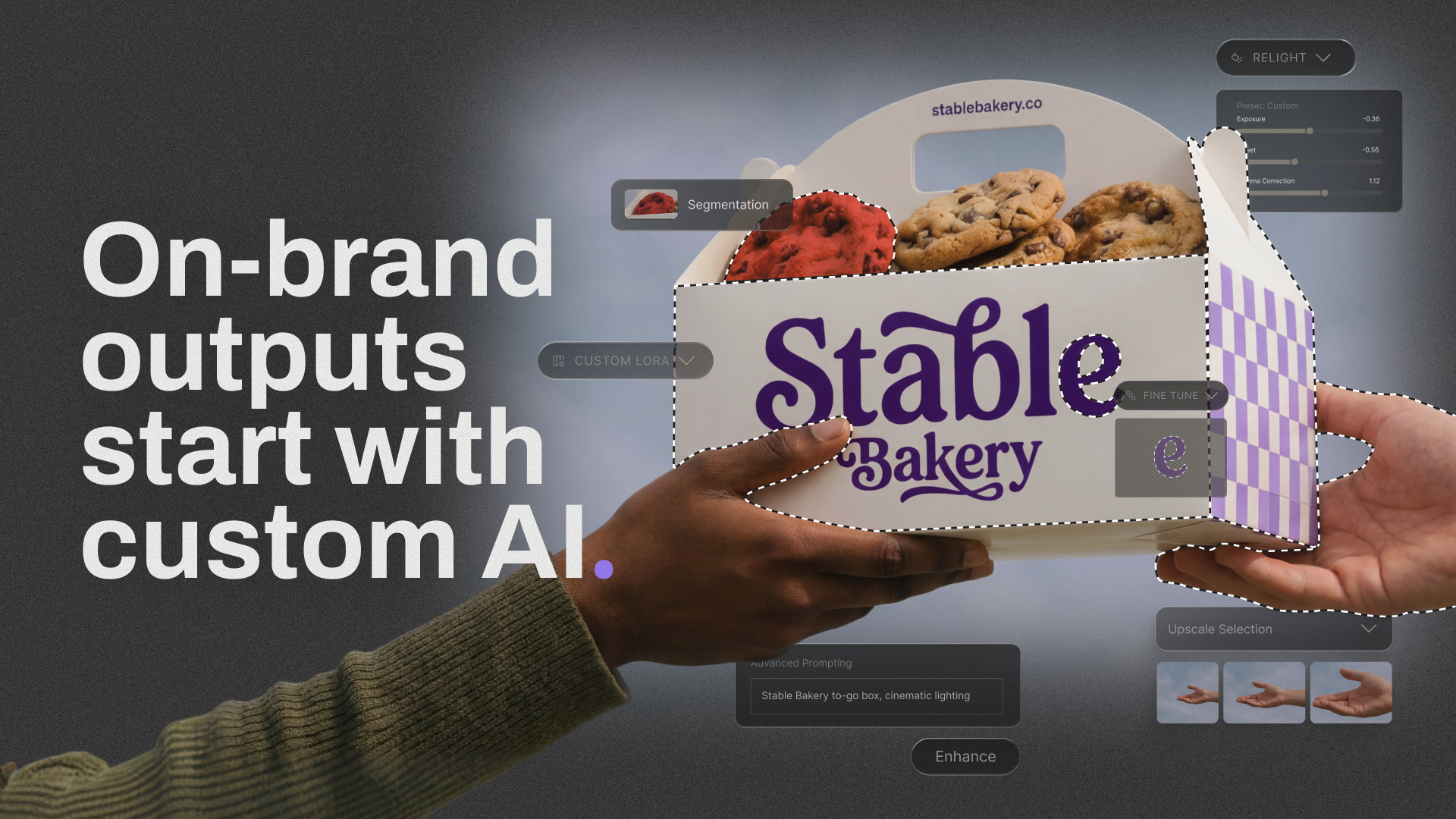
Customizing AI means you embed brand guidelines directly into your models and processes, reducing the need for repetitive prompting and ensuring consistent, on-brand results.
Why bother customizing an AI model, when you can get good results through advanced prompting with out-of-the-box models?
Let’s imagine you’re running a bakery. You’ve got your secret recipe down for THE chocolate chip cookie. Gooey in the middle, crisp on the edges, the chocolate still melty when it breaks open. People recognize it immediately. It’s your brand’s signature cookie.
Then someone invents boxed cookie mix.
And the box makes it easier, faster, and cheaper for anyone to bake cookies.So everyone’s using the box. Your competitor down the street is using the box. And they’re cranking cookies out faster, but they all kind of taste like slop.
But wait! Your chefs can still adapt the box, right? With some very specific, detailed prompts…err, recipe tweaks…you can get the cookies back to being exactly right.
Except that’s not what happens.
You spend precious time trying to get someone else’s box to come out like your own.
Why trained AI models outperform prompt engineering
Exciting new mixes keep coming out that look promising, and they still crumble in production.
If you’re a creative leader, this is a familiar story. You’ve dealt with the frustration of being told to use out-of-the-box AI models to produce work that’s faster, cheaper, and still good…only to find that models don’t quite get it right.
Prompt engineering has been the solution so far. It’s how we’ve been translating human intent into something AI can understand, and it’s still a valuable skill.
But advanced prompting is a stopgap, not a long-term strategy. Instead, enterprises are investing in customization: Training models and building repeatable processes specifically for their brand.
It’s a little more upfront work that goes a long way. Read on to see why.
1. Why does prompt engineering fail to produce consistent results?
Because prompting introduces complexity.
Most people start in the same place. You open an out-of-the-box model, write a prompt, and it does something surprisingly good.
But to get to brand-accurate, your prompts start growing. They become 50-word mega-prompts filled with keywords and technical jargon. In fact, you start to need help from an LLM to formulate the prompt because it’s gotten so complicated and lengthy it’s beyond your understanding.
And complex prompts aren’t just time-consuming, they’re credit-consuming. You’re paying over and over to remind the model who your brand is.
You’re paying over and over to remind the model who your brand is.
How customization helps: Translating brand language into model language
Under the hood, technical experts can build your brand guidelines directly into the model so you don’t have to engineer them every time you prompt. Stability AI translates abstract concepts like “urban loft aesthetic” or “Negative space for logo placement” into technical data the model processes automatically.
That way, you can focus on creative direction in your prompt instead of repetitive instructions, as it will adhere to the preset brand guidelines.
A tale of two prompts:
Same intent, way different effort.
|
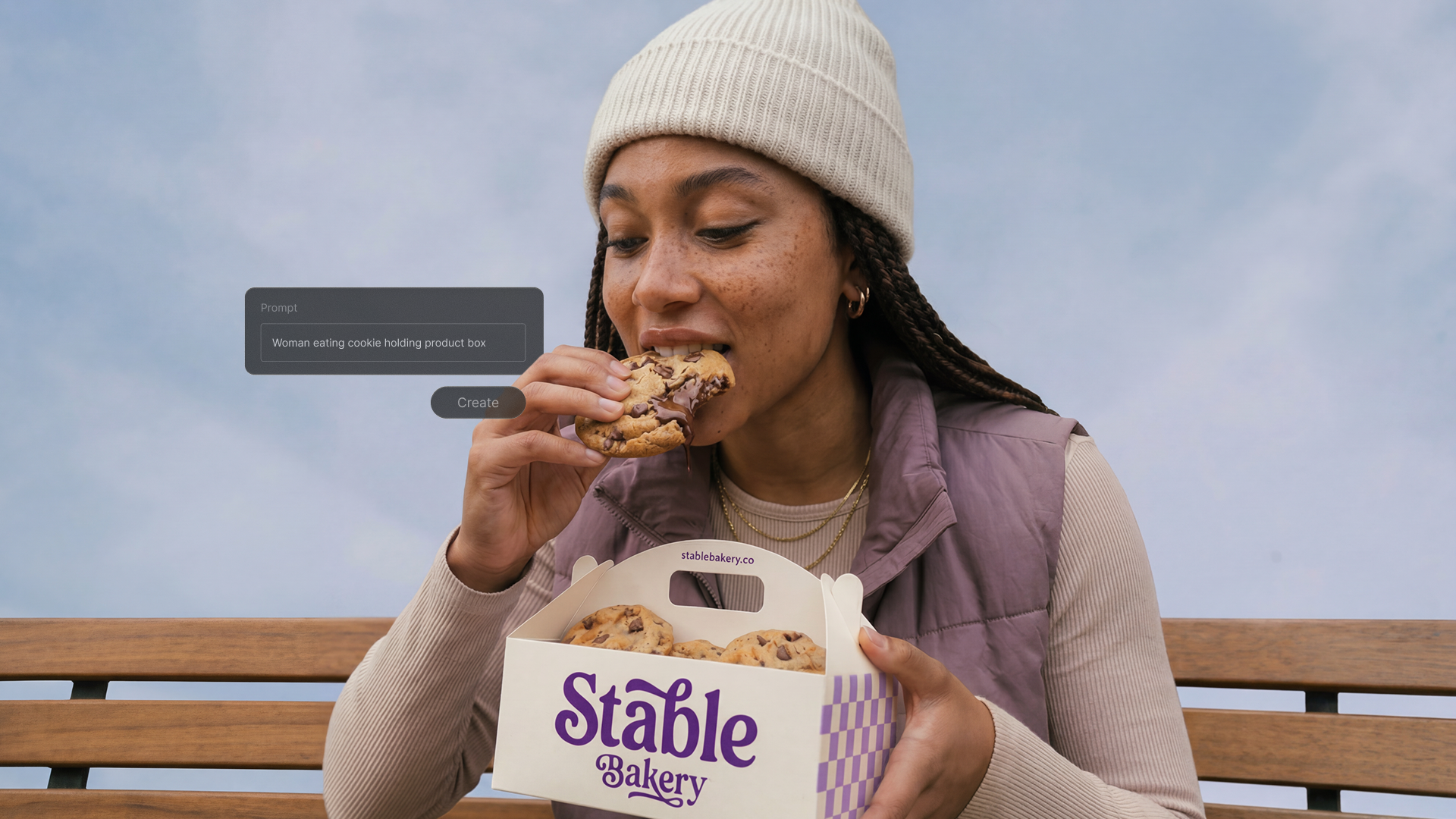
Prompt: A premium editorial lifestyle campaign portrait with elevated Gen Z energy in a modern fashion-meets-bakery advertising style. Subject is a young African-American woman with long neat braids, freckles, warm brown skin, and realistic natural skin texture with visible pores. She is seated outdoors on a simple wooden bench, holding a thick chocolate chip cookie near her mouth and caught in the quiet in-between moment just before the bite. Her lips are softly parted around the edge of the cookie, her eyes are looking down at the bite, and her expression feels calm, indulgent, and focused on the cookie rather than overly smiley or exaggerated. In her other hand she holds a branded Stable Bakery cookie box filled with cookies, clearly visible in frame. Clothing and styling: She wears an off-white ribbed knit beanie, a muted dusty-purple puffer vest, and a fitted beige ribbed long-sleeve top. Jewelry is minimal and refined with thin layered gold chains and small gold hoop earrings. Styling feels youthful, elevated, relaxed, and modern. Lighting: Soft natural daylight with an overcast feel. Light is diffused and flattering with gentle shadow shape, natural skin detail, and a soft highlight on the cookie to emphasize the melted chocolate and texture. Background: A minimal cloudy sky in cool grey-blue tones with a simple wooden bench behind her. No visual clutter, no distracting background elements. Color grading: Clean, soft, and natural with slightly muted tones. Cool grey-blue background balanced by warm skin tones and warm bakery browns. Overall image feels airy, premium, and grounded, not glossy or overly saturated. Product consistency: The cookie is thick, golden brown, soft, and bakery-made with visible melted chocolate and realistic crumb texture. The Stable Bakery box is off-white with bold purple branding and a purple (#A381FF) checker pattern, filled with multiple cookies and always looking premium, clean, and clearly legible. |
Prompt with a custom model: Woman eating cookie holding product box |
2. What are the challenges of scaling prompt engineering across an organization?
Relying on prompting is unscalable because it creates inconsistency and slows teams down. But that’s how organizations are trying to approach it.
For brands Stability AI works with, the goal is usually to scale AI use across the entire marketing org. That means teams across regions who need to create assets that are consistent. And most of them aren’t going to be expertly prompting to get the correct output.
Without customization, teams get bogged down trying to get outputs to meet brand standards, slowing them down and defeating the purpose of AI adoption. You need to be able to empower your team while governing how assets are created.
How customization helps: Build once, use many
Custom AI training improves creative workflow efficiency. You capture the expertise once and distribute it everywhere. You don’t need 100 expert prompters. You need one great recipe and a setup that enforces it.
For instance, instead of prompting for a specific lighting style with a paragraph-long explanation, you can create a custom Style Preset for lighting that gets applied to every output.
3. Are out-of-the-box AI models enough for brand consistency?
When you prompt a generic box model, you’re just baking with someone else’s mix. Your competitor is likely using the same model you are. This is problematic for a few reasons:
Cross-pollination: If employees are using personal AI tools for work tasks without IT permission – which 90 percent of employees are doing – they’re sharing your brand’s secret recipe with the public models.
Generalized results: When you prompt, you're invoking the general version of that element (e.g. a cookie). That means the model is still going to have a bias toward the average of its training data. In other words, it’s been trained on 10,000 images of cookies, and your cookie is going to start to look the same as your competitor’s cookie.
Turns out a lot of foundation models, generic, general foundation models, they’re black box. They’re incredibly capable across a range of tasks, but not very good at very specific tasks. So how do you make them more capable of specific tasks? Turns out you need deep customization.
Source: Electronic ArtsHow customization helps: Build something no one else has
Instead of the model trying to guess what you want by looking at 10,000 cookies, it starts with your specific style as the baseline. Your brand assets also stay within your own walls. You’ve stopped using a public utility and started using a process that no one else can buy or replicate.
When should creative teams use prompt engineering vs. custom models?
There is still a time and place for more advanced prompting.
For a handful of generations that don't need to be exactly on-brand, prompt engineering is a great start. Here are some examples of when prompting is enough, and which use cases require the precision and repeatability of customization.
| Advanced Prompting | Customization |
|---|---|
| Concepting & prototyping: Rapidly explore artistic styles, lighting, and textures for initial concepts. | On-brand output: Train a custom brand foundation model to get exact brand standards right, so results are consistently production-quality. This can include color palette, mood, lighting, setting and more. |
| Consumer-grade stock replacement: Generate higher-quality assets like "a modern office" or "scenic mountain landscape." | Product photography: Create images featuring your specific products or other brand-specific objects. Preserve product fidelity to make sure every detail is right. |
| Quick edits: When you’re using editing tools to make final tweaks like inpainting (adding an object) or outpainting (expanding a frame). | Complex processes like localization: Build repeatable use cases that require multiple steps (such as localizing an image with the right setting and product packaging). |
What’s next: It’s a recipe, not a prompt
Prompting gets you surprisingly far. But there’s a ceiling to it, and most brand teams hit that ceiling way faster than they expect. Because your brand can‘t be reduced to a one-size-fits-all model.
The moment something becomes repeatable, brand-sensitive, or business-critical, prompting starts to show cracks. That’s when you need to stop trying to use a model as-is.
Only you know exactly what goes into your brand and your creative process. It’s your taste and expertise. You’re the one who can make sure the AI knows your recipe and can reproduce it consistently at the quality you need.
Want to start customizing?
Stability AI helps leading brands through the creative process of training custom models on everything that makes up your brand’s look and feel. And we can do it in a matter of weeks. To learn more about how we can collaborate, reach out here.
